Houghton House
Drug rehab Johannesburg
Inpatient drug addiction treatment centre with medically-supervised drug detox, 24-hour nursing, and on-site psychiatric care.
Effective drug rehab requires medical and psychological care in addition to a safe environment to recover from substance abuse. At Houghton House Addiction Recovery Centre in Johannesburg, our dual diagnosis addiction treatment approach addresses any co-occurring mental health conditions as part of our evidence-based drug addiction rehabilitation programme.

Medically supervised drug detox
Most of our drug rehab programme patients begin treatment with drug detox. Withdrawal from alcohol, benzodiazepines, opioids, and mandrax, can cause seizures, severe dehydration, and cardiac complications, which is why detoxing from drugs at home is dangerous without clinical supervision.
Our medical detox programme runs inside a fully licensed private psychiatric hospital, with daily visits from medical doctors and full-time nursing supervision. Detox begins with an intake assessment, then moves through active withdrawal management, stabilisation, and round-the-clock care. The dedicated detox phase typically lasts three days, and South African medical aid schemes are legally required to cover that period.
Where withdrawal is severe, our doctors prescribe medication to ease the patient’s discomfort and adjust the protocol as symptoms change. Detox stabilises the body, and the therapeutic work that follows addresses what drove the substance use in the first place.

Signs of drug addiction: When does drug use become a problem?
Recognising when drug use has crossed from recreation into dependence is difficult, particularly from the inside. What starts as occasional use can develop into a pattern that feels impossible to control. Tolerance builds over time, meaning you need more of the substance to achieve the same effect. Warning signs that drug use may have become a problem include:
- Using more of the substance than you intended
- Needing larger or more frequent doses to achieve the same effect
- Spending a lot of time obtaining, using, or recovering from drugs
- Neglecting work, studies, or family responsibilities
- Continuing to use despite health issues or conflict at home
- Experiencing withdrawal symptoms like cravings, irritability, or anxiety when not using
- Trying to stop using drugs, but finding you can’t on your own
If several of these signs sound familiar, speak to our admissions team for a confidential assessment.
Dual diagnosis treatment for addiction and mental health
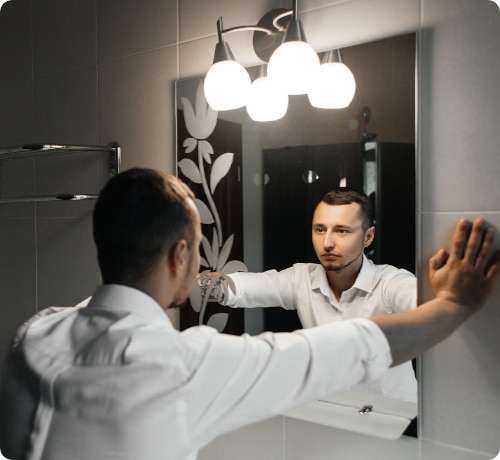
Drug addiction, also known as substance use disorder (SUD), is a chronic condition that changes the way your brain functions. Repeated use alters the brain’s reward and stress systems, creating powerful cravings and making it increasingly difficult to stop. To make matters worse, many people who use drugs also live with with untreated mental health issues such as depression, anxiety, or trauma. For some, drug use starts as a way of self-medicating to cope.
At Houghton House drug rehab, every patient is assessed for co-occurring mental health conditions as part of the standard intake process. Where another condition is present alongside addiction, our clinical team treats both at the same time rather than one after the other.
Treating addiction while leaving an underlying condition unaddressed raises the likelihood of relapse. As a dual-licensed psychiatric hospital and rehabilitation facility, Houghton House provides psychiatric care and addiction treatment under one roof, which most drug rehabilitation centres in South Africa aren’t licensed to do.

Our drug rehabilitation programme: What treatment involves
Our standard inpatient drug rehabilitation programme runs for 30 days, combining therapy, education, and personal development on a set daily schedule. Treatment is tailored to each patient and guided by a multidisciplinary team of psychiatrists, psychologists, counsellors, and nursing staff. Every component is designed to help patients build awareness, skills, and resilience.
The programme includes:
- Supervised medical detox
- Daily therapy schedule
- CBT and DBT
- 12-step facilitation
- Psychoeducation
- Trauma and grief therapy
- Group therapy
- Individual counselling
- Relapse prevention
- Mindfulness & meditation
- Biokinetics & exercise
- Family participation
A rigorous daily therapeutic routine
Treatment at Houghton House follows a set daily schedule. Patients know when therapy begins, when meals are, and when they have free time. That consistency is deliberate, because unplanned time carries risk in early recovery. A predictable routine removes some of that pressure while patients build the capacity to manage it themselves.
Within that framework, the clinical team adapts to each patient. Some need their thinking challenged directly; others need space to process. Counsellors make those calls based on what they observe rather than on a formula. The 12-step stepwork programme runs alongside individual counselling and group therapy throughout.
Holistic, evidence-based addiction treatment
Treatment at Houghton House focuses on what drives substance use rather than the substance alone. Patients work with therapists to identify the thought patterns, emotions, and situations that sustain addiction, and develop concrete strategies for managing them differently.
Our licensing as a private psychiatric hospital means medical care, individual therapy, group work, and family involvement all sit within a single rehab programme, rather than being referred out to separate practitioners.
Long-term addiction recovery support and aftercare
Discharge from inpatient care doesn’t end the recovery process. Patients who complete the inpatient programme move on to our aftercare programme, which reinforces the skills developed during treatment and keeps them connected to a recovery community.
We also run halfway houses for patients who need a gradual transition into independent living. Both options keep patients supported through the period when relapse risk is highest.



Medical aid cover for drug addiction treatment
Houghton House is dual-licensed as both a psychiatric hospital and a rehabilitation facility. Under South Africa’s prescribed minimum benefits laws, all registered medical aid schemes must cover treatment for substance use disorder, regardless of what plan you’re on. For most patients, this means no copayments, though the exact scope of cover depends on your scheme and benefit year.
What cover for drug rehab typically looks like:
- 3 days of hospital-based medical detox
- Up to 21 days of inpatient substance abuse treatment
- Up to 21 days of inpatient psychiatric care (where a co-occurring condition qualifies under psychiatric PMBs)
- A once-off R1,850 admission fee, payable upfront and usually the only out-of-pocket cost
Confirm your cover before you commit
Call +27 11 787 9142 or WhatsApp 079 770 7532, and our admissions team will verify your medical aid benefits at no cost and with no obligation.
Here’s how Houghton House drug rehabilitation centre has helped people like you


Frequently asked questions about drug rehab
Stopping drug use on your own can be extremely difficult and, in some cases, unsafe. When the body has developed dependence, suddenly quitting can trigger strong cravings, withdrawal symptoms, and emotional distress that make relapse more likely.
The safest way to stop using drugs is with medical and therapeutic support. At Houghton House, patients begin recovery through a supervised detox programme, where withdrawal is managed in a safe and controlled environment. Individual and group therapy then uncover the emotional, psychological, and situational triggers that fuel substance use.
Treatment also develops practical relapse-prevention skills, rebuilds daily routine, and addresses co-occurring mental health conditions such as anxiety or depression. Our multidisciplinary team works with each patient to create a personalised recovery plan.
If you or someone you care about needs help, you can contact Houghton House for a confidential assessment at +27 11 787 9142, or call our 24/7 helpline at +27 79 770 7532.
Houghton House treats all forms of substance dependence, including prescription drug addiction (opioid painkillers, benzodiazepines, sleeping medication, and stimulants), alcohol dependence, cannabis, heroin, mandrax, cocaine, crystal meth (tik), and other illicit substances. Each patient receives a programme tailored to their substance history and clinical needs.
Treatment begins with a comprehensive psychiatric assessment and, where necessary, a medically supervised detox to manage drug withdrawal symptoms safely. Therapy follows, including individual and group counselling, CBT, DBT, trauma therapy, mindfulness, and relapse prevention.
Dual diagnosis treatment addresses addiction and mental health conditions such as depression, anxiety, or trauma at the same time. Houghton House is licensed as both a psychiatric hospital and an addiction treatment centre, which allows patients to receive integrated care under one roof. To learn more, read our blog Dual diagnosis: When mental health and addiction collide.
Our standard inpatient drug rehab programme runs for 30 days. That comprises 24 days in our primary care facility followed by six days in secondary care, and the second phase can extend to 18 days where clinically indicated.
After inpatient treatment, you’ll move into our aftercare programme. We strongly recommend continuing to attend regular NA meetings until you’re at least one year sober.
Thirty days is the minimum needed to do three things: clear the substance from the body, stabilise the patient medically and emotionally, and begin meaningful therapy. None of them can be rushed.
Detox and stabilisation usually take up the first week or two. Withdrawal from alcohol, benzodiazepines, or opioids can be life-threatening without clinical supervision, and managing it safely takes time.
Once a patient is medically stable, the therapeutic work begins in earnest. Patients here have therapy or activity scheduled every hour from 06:00 to 20:00, because that consistency changes behaviour faster than a shorter stay allows.
A month also gives the clinical team time to understand what they’re treating. Most patients arrive with a co-occurring condition such as depression, anxiety, or trauma. Assessing that accurately, then treating both alongside each other, can’t be compressed.
There’s a neuroscience case for the duration too. Prolonged substance use alters brain chemistry and neural pathways, and full cognitive function can take up to 90 days to return after someone stops using. The 12-step fellowship’s recommendation of “90 meetings in 90 days” came from lived experience, and addiction medicine now explains why it holds. The first three months are when the brain is most vulnerable to relapse and least equipped to make sound decisions, and 30 days of inpatient care covers the most acute part of that window.
In our experience, patients who reach twelve months of continuous abstinence are considerably more likely to sustain long-term recovery. Thirty days sets that up rather than completing it, which is why we recommend building on it with secondary care, aftercare, and ongoing support.
Inpatient treatment gives patients the tools, and aftercare is where they put those tools to consistent use. Houghton House offers continued support through our aftercare programme, outpatient therapy, and halfway houses.
Yes. Family involvement forms part of the treatment programme, and we hold family sessions on Thursdays from 17:30 to 19:00 at 420 York Avenue, Ferndale. Family support continues after discharge, because recovery affects the household as much as the patient.
Some people reduce or stop drug use without entering a programme, but the risks depend heavily on the substance and the severity of dependence. Withdrawal from opioids, benzodiazepines, and alcohol can produce dangerous complications, including seizures, and needs clinical supervision.
Relapse rates are also higher without support. Detox alone addresses physical dependence, and the psychological drivers behind substance use usually need therapeutic work to change.
Yes. Houghton House treats dependence on opioid painkillers, benzodiazepines, sleeping medication, and prescription stimulants. This kind of dependence often develops from legitimate medical use, and many patients are surprised by how quickly tolerance builds.
Withdrawal from benzodiazepines and opioids carries a risk of serious complications and needs medical supervision. Treatment falls under prescribed minimum benefit cover in the same way as any other substance use disorder.
Drug detox manages withdrawal while the substance clears your system. Detox at Houghton House begins with an intake assessment, then moves through active withdrawal management, stabilisation, and round-the-clock nursing care. The dedicated phase typically lasts three days.
Doctors visit daily and nursing supervision runs 24 hours. Where symptoms warrant it, our medical team prescribes medication to ease discomfort and adjusts the protocol as withdrawal progresses.
Detox is particularly important for alcohol, benzodiazepines, opioids, and mandrax, where withdrawal without supervision can be life-threatening.
For patients on a registered medical aid, substance use disorder is a prescribed minimum benefit, which means your scheme is legally required to cover treatment regardless of your plan. In most cases the only upfront cost is a once-off R1,850 admission fee.
Costs for self-funded patients depend on the length and level of care required. The cost of 30 days of inpatient care typically falls in the range of R92,000-R102,000, while outpatient treatment typically costs between R17,000 and R26,000 depending on duration. Our admissions team can give you a full quote over the phone, with no obligation.
If private treatment isn’t affordable, our resources page lists government-funded and subsidised rehabilitation centres across South Africa.
Start by calling our admissions team, who will talk through the situation and advise on the options. Where someone is unwilling to accept help, a family intervention often creates the opening. Our intervention process brings a trained facilitator together with the family to plan and hold that conversation.
Admission can happen quickly once the decision is made, and our team will verify medical aid cover before the patient arrives.
Proud member of
the National Hospital
Network