
Addiction is a family disease
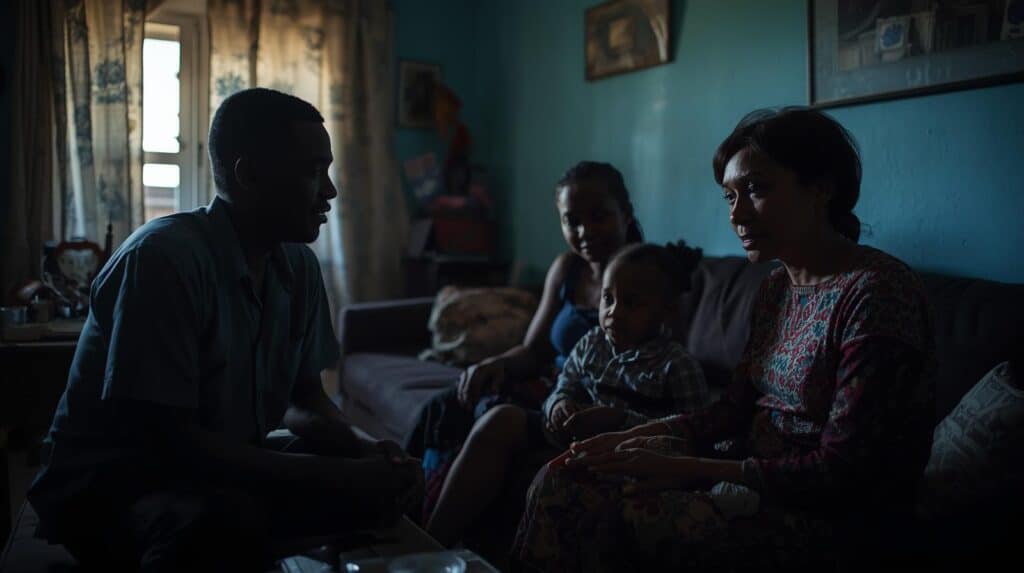
When someone in a family develops an addiction, the effects don’t stay contained to that one person. Partners absorb the chaos. Children adapt to unpredictability. Siblings take on roles they didn’t choose. Parents carry guilt that has nowhere to land. The whole family system reorganises itself around the addiction, over months or years, without anyone noticing.
This is what clinicians mean when they say addiction is a family disease: that addiction changes family dynamics in ways that can become as entrenched — and as difficult to change — as the addiction itself.
This article covers the most common effects of addiction on families, why they develop, and what families can do.
How addiction affects the family
Addiction’s impact on families is wide-ranging. The effects below are ones many families recognise immediately, even if they’ve never had words for them.
- Financial strain: Addiction costs families money in ways both direct and indirect, including money spent on substances or gambling, lost or unstable income, accumulated debt, and financial decisions made to protect the person with the addiction from consequences.
- Verbal and emotional abuse: Family members often bear the brunt of behaviour changes that accompany addiction, including mood swings, outbursts, manipulation, and chronic unpredictability. Many have normalised treatment that, in any other context, they would recognise as abusive.
- Neglect: Children and other dependants may not receive the care, attention, or supervision they need, ranging from emotional unavailability to basic practical needs going unmet.
- Violence: Not every family experiences physical violence, but the risk is real, and fear of volatility shapes behaviour long before any incident occurs.
- Isolation and shame: Families affected by addiction frequently withdraw from social life, both to manage unpredictability and to avoid having to explain what is happening at home. Shame keeps many from asking for help until a crisis forces the issue.
For many families, even acknowledging that these experiences aren’t normal or healthy can feel like disloyalty. Seeing them clearly — and recognising their dysfunction — is what makes a different response possible.
The less obvious effects of addiction on the family
Addiction also produces changes that are harder to name, affecting how family members relate to each other, how they see themselves, and how they function in relationships beyond the family home.
None of these patterns develops deliberately. Most accumulate over years of adapting to an unpredictable situation. By the time a family seeks help, they’ve often become so familiar that they no longer seem unusual.
Without support, many of these patterns persist long after the addiction has been addressed, with lasting effects on mental health, self-esteem, and capacity for trust.
Hypervigilance
Children living with an addicted parent often become hypervigilant, meaning they become acutely sensitive to mood and atmosphere. Constantly scanning for signs of what to expect, even small cues can take on outsized significance: a certain tone of voice, a long pause, or the sound of a key in the door.
In an unpredictable home environment, alertness becomes a survival strategy. When a parent’s mood, behaviour, or reliability can change without warning, learning to read the room is a way of staying safe and reducing the risk of conflict or harm.
Hypervigilance develops because the environment genuinely warrants it, but the pattern doesn’t resolve when the child leaves home. Adults who developed hypervigilance in childhood often carry it into adult relationships, where it can show up as chronic anxiety, difficulty trusting others, or a tendency to read threats into neutral situations.
Early support for children in these households can interrupt the pattern before it becomes entrenched.
Parentification
Parentification describes what happens when a child takes on responsibilities that belong to an adult. In families affected by addiction, this often means managing younger siblings, mediating conflict, or providing emotional support to the non-addicted parent. The roles accumulate without anyone explicitly asking. The child steps in because someone has to.
The child’s own developmental needs get pushed aside in the process. Time and attention that should go towards friendships, learning, and ordinary growing up go instead towards holding the family together. Children in this role often describe feeling older than their years, responsible for things beyond their control, and guilty when things go wrong.
For parents in recovery, addressing parentification means actively taking back adult responsibilities that have fallen to children. This requires honest conversations about what has changed, and giving children explicit permission to step out of roles they were never meant to hold. Working through these changes in family therapy is often the most effective approach.
Adverse Childhood Experiences (ACEs)
Growing up with a parent with addiction is classified as an Adverse Childhood Experience (ACE), one of ten categories of childhood adversity identified in the ACE Study, a landmark piece of research conducted in the late 1990s. The study found that exposure to adverse childhood experiences predicted significantly higher rates of physical and mental health problems in adulthood, including a greater risk of developing addiction.
The implications for children of addicts are significant. Higher ACE scores correlate with higher rates of depression, anxiety, substance use, and chronic physical health conditions in adulthood. Protective factors like stable relationships, strong attachment figures, and early support meaningfully reduce the risk, even where ACE scores are high.
For families, ACE research makes a clear case for early support for children, rather than waiting to see whether effects resolve on their own. The ACE findings also point to why recovery that addresses the whole family, and not only the individual with addiction, produces better long-term outcomes.
Enabling
Enabling describes a pattern in which family members protect the person with the addiction from the consequences of their behaviour. The pattern is rarely intentional. Common examples of enabling behaviour include making excuses to employers, lending money to cover gaps, downplaying the problem to others, or absorbing consequences on their behalf.
Enabling is difficult to recognise and harder to stop because, to the person doing it, it looks like love. When someone you care about is in pain or in danger, the impulse to remove that pain is natural. The problem is that removing consequences also removes one of the key pressures for change.
Changing enabling behaviour means maintaining genuine care while also allowing consequences to land. Most families find they need support to work through this. A family counsellor or support programme can help build specific alternative responses for situations that typically trigger enabling.
Codependence
Over time, some family members become codependent, meaning their own emotional well-being becomes entangled with the behaviour of the person with the addiction: whether they’re using, how they’re coping, whether they seem to be improving. When things are going well, the family member feels relieved. When things deteriorate, the family member struggles too.
Codependence typically takes hold in response to the intensity of living with someone whose behaviour is unpredictable and whose safety is a constant concern. The family member’s sense of self — and of what a normal day looks like — reorganises around the other person’s state. Hobbies, friendships, and personal goals contract as the demands of managing the relationship grow.
Codependence often goes unrecognised because it looks like devotion. Getting support for oneself is part of recovery, for the family member as much as for the person with the addiction. Family therapy and dedicated support programmes address these relational patterns directly.
Burnout
Family members who spend months or years managing the impact of someone else’s addiction often experience burnout, a state of emotional exhaustion beyond ordinary tiredness.
Burnout is caused by chronic stress, repeated crises, and the weight of caring about someone who may not want help at all. It can look like withdrawal, growing irritability, a sense of hopelessness, or a flatness that’s hard to explain.
Burnout often goes unrecognised until it becomes severe. In some cases, it deepens into depression. At that point, support is essential. Family members at this level of depletion cannot meaningfully support a loved one, and attempting to do so often deepens the exhaustion.
Getting support — whether through individual therapy, a support group, or a dedicated programme — allows family members to begin restoring what chronic stress has taken, and to re-engage with the recovery process from a more sustainable position.
How to get help as a family
The instruction on airplanes to put on your own oxygen mask before helping others exists for a reason. A family member who has addressed their own needs is better positioned to help during recovery than one who is depleted, codependent, or operating from fear. Support for the family and treatment for the person with the addiction are part of the same effort.
Several avenues are available to families in South Africa, and many people find that a combination works best:
Individual therapy
When a family member has been living alongside someone’s addiction for months or years, the effects don’t stay contained to the relationship. Anxiety, depression, disrupted sleep, and a persistent sense of dread are common.
Individual therapy gives family members a space to address their own experience, separate from the question of what to do about the person with the addiction.
Individual therapy is particularly relevant for family members dealing with burnout or codependence, where the priority is rebuilding a sense of self that has become organised around someone else’s state. A therapist who understands addiction and family systems can help identify patterns that are difficult to recognise from inside the relationship.
Family therapy
Family therapy brings the household together to work on the relational patterns that have formed around the addiction: communication styles, role distribution, enabling, and the rebuilding of trust. It’s most effective once the person with the addiction is in recovery, though some families begin before that point.
The focus is on giving everyone a shared language for what has happened and a structured way to work through it together.
Support groups
Support groups offer something individual therapy often can’t: the perspective of people who have loved someone through addiction. Members share practical experience on setting limits, recognising enabling behaviour, and managing fear.
- Al-Anon and Nar-Anon both operate in South Africa and run regular meetings for families of people with alcohol and drug addictions, respectively.
- SANCA (the South African National Council on Alcoholism and Drug Dependence) also offers counselling and referrals for families, and is often a useful first contact for those who don’t know where to start.
- AA and NA both hold open meetings that family members can attend. Attending gives people a chance to understand the recovery process from the inside, which many family members find helps reduce frustration and build empathy.
- Gam-Anon runs support group meetings for the loved ones of people with a gambling disorder or compulsive gambling.
Many families find that belonging to a group brings a sense of community and, over time, genuine hope.
Addiction rehab family support programmes
Many alcohol and drug rehabilitation centres offer a weekly support programme for family members, providing mutual support, education on addiction, communication skills, and practical strategies for managing enabling and self-care.
A note on resistance to help
If your loved one is in denial and refuses to accept help, a professional intervention may be worth considering. A trained interventionist brings together the people closest to the person with the addiction to confront the situation directly and ask for a commitment to treatment.
If you’re considering this route, we strongly recommend speaking to our team first. We can guide you through the process, what to expect, and how to prepare.
For more information and tips, read What to do when someone won’t get help.
The family support programme at Houghton House
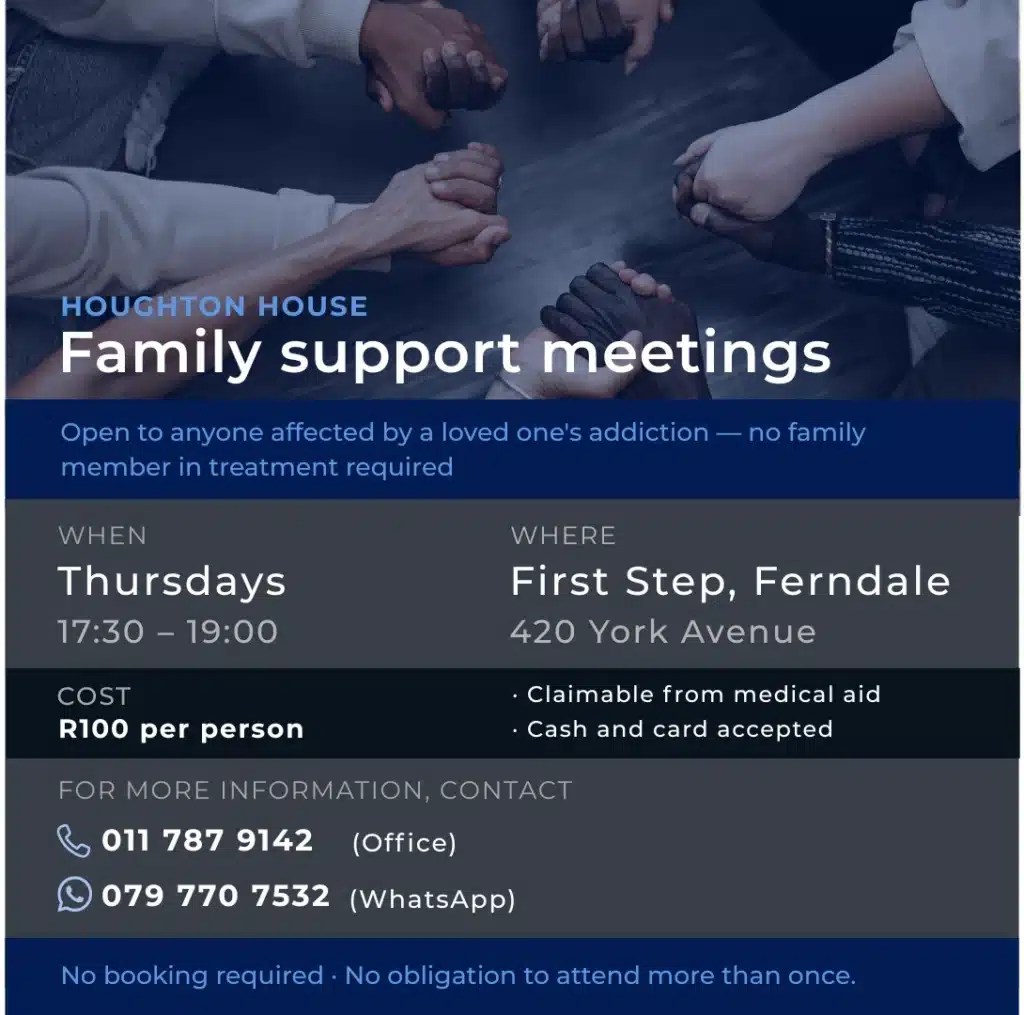
Houghton House runs a dedicated family support programme for anyone with a loved one affected by addiction, whether that person is currently in treatment or still struggling. Sessions are facilitated by certified addiction counsellors and psychologists, and are open to anyone with a loved one affected by addiction, whether or not they’re currently in treatment at Houghton House.
Here’s what you need to know:
- Certified addiction counsellors and psychologists facilitate the family support sessions.
- Sessions run every Thursday from 17:30 to 19:00
- Sessions are held at First Step, at 420 York Avenue, Ferndale.
- The cost is R100 per person, claimable through medical aid.
- You don’t need to be a patient’s family member to attend.
- Your loved one doesn’t need to be receiving care at Houghton House.
Each session covers:
- Education on addiction and recovery
- Setting and maintaining healthy boundaries
- Communication skills for difficult conversations
- Self-care for family members
- Recognising and changing enabling patterns
Talk to us
Most families dealing with addiction carry it alone for longer than they need to. Don’t wait for a crisis before you reach out for help.
To find out more about Houghton House’s family support programme, or to talk to our team about your situation, call us at any time at 079 770 7532, or get in touch online.
