
Gambling addiction: Causes, signs, and how to get help

This article covers what gambling addiction is, how to recognise the signs, why online gambling carries particular risks, how to stop gambling, and what treatment involves for those who need clinical support.
Gambling in South Africa
Gambling has become increasingly popular nationally. South Africa’s gambling industry grew to over R1.5 trillion in 2024/25, a 31.3% increase from the previous year, which in turn was 40% higher than the preceding year.
According to recent news reports, the South African Responsible Gambling Foundation (SARGF) helpline received more than 1.1 million calls in 2024/25, up from just 140,000 calls for help the previous year — a 623% increase.
South African gambling statistics worth noting
- 52% of working South African adults gamble. The most active gamblers are 30-49-year-olds (58%) and men (57%). (Old Mutual)
- 70% of surveyed gamblers gamble to supplement their income, rather than for entertainment. (BusinessTech)
- Gambling activities accounted for 1.6% of total household spending and 55% of household spending on recreation in 2025 (Statistics SA)
- 35% of people who have received help from SARGF for problem gambling are unemployed and rely on SASSA social grants. (SARGF)
- 41% of low-income earners earning between R8,000 and R15,000 per month gamble to cover household expenses or manage debt. (Old Mutual)
- 58% of total credit card spend in South Africa went to online gambling in 2024 — up from 26% in 2022. (Absa)
- Students gambling away their National Student Financial Aid Scheme (NSFAS) allowances online is such a widespread issue that NSFAS has partnered with the National Gambling Board (NGB) to curb this trend. (NSFAS)
Behind these numbers is a growing public health concern. With the rising popularity of online betting sites and mobile gambling apps, gambling has crossed the line from a leisure activity to something that is causing serious financial and psychological harm at scale. For hundreds of thousands of South Africans, gambling addiction is a daily struggle.
What is gambling addiction?
Gambling addiction or gambling disorder is a recognised behavioural addiction in which a person continues to gamble despite the negative consequences of their habit. Also referred to as compulsive gambling or ludomania, gambling addiction involves a persistent and uncontrollable urge to gamble that willpower alone cannot overcome.
Many people with gambling addiction experience distorted thinking patterns that sustain the behaviour. Common examples include:
- Believing they can “win back” their losses
- Believing that near-misses signal an upcoming win,
- Believing they can predict outcomes in games of chance by observing patterns in the outcomes of previous games
- Thinking their “system” or “strategy” will eventually pay off
- Superstitious beliefs (and even personal rituals and rules) around luck
These beliefs sustain the behaviour long after the financial and emotional damage has become serious.
The financial strain gambling causes often leads to significant debt and, in some cases, to financial crimes like theft or fraud, to cover losses or fund the gambling addiction.
Gambling disorder also significantly raises the risk of suicide, according to a recent meta-analysis of research papers on the relationship between suicide and gambling addiction from around the globe. This finding reinforces the case for early intervention, particularly given that many people with gambling addiction delay seeking help out of shame.
The rise of online gambling addiction
Online gambling has made gambling addiction more accessible than ever before. These days, there’s no need to travel to a physical venue like a casino or betting shop to gamble. A betting app requires only a smartphone and a payment method. Every smartphone is a potential entry point, available at any hour.
Several features of online gambling platforms increase addiction risk:
- 24/7 availability, with no closing time or natural interruptions to break the gambler’s focus
- Push notifications and promotional offers are designed to pull users back
- Fast, frictionless deposit mechanisms promote impulsive financial decisions
- Live betting and in-play markets keep engagement continuous
- Anonymity reduces social accountability and makes it easier to hide the extent of the problem
South Africa’s online gambling sector is growing rapidly, and sports betting apps have become one of the most common pathways into problem gambling.
Regulation hasn’t kept pace, allowing many gambling sites and apps to exploit legal loopholes to operate even though most online gambling (including interactive online casino games like roulette and blackjack) remains illegal in South Africa.
Predatory advertising is widespread in the online gambling industry, with gambling platforms often using misleading promotional tactics to attract and retain users. Most platforms also use aggressive retention strategies to lure inactive users back with personalised offers like “free” bets or wallet credits, typically hiding the wagering requirements in the fine print. Most, in fact, have minimum withdrawal limits that prevent users from accessing this “free money” without actually playing, as many economically vulnerable users quickly discover.
The speed and accessibility of these apps make it easy to place bets impulsively, and the social normalisation of sports betting in South Africa, particularly among young men, means many people don’t recognise their gambling as a problem until the financial consequences become impossible to ignore.
The growing mainstream popularity of prediction markets like Kalshi and Polymarket is also making it harder to recognise when someone is developing a real gambling problem.
If your gambling has shifted primarily to apps or websites, or if you find yourself gambling late at night or in private, these are warning signs worth taking seriously.
What causes gambling addiction? How gambling affects the brain
As is the case with other addictions, gambling disorder is tied to psychological and emotional factors and almost always co-occurs with other mental health issues. Gambling disorder is often comorbid with depression, anxiety, trauma, bipolar disorder, autism, ADHD, and other psychiatric conditions.
Gambling activates the same reward pathways in the brain as substance addiction. Each win or near miss triggers a dopamine release that rewards the behaviour, reinforcing the urge to repeat it. Over time, the brain adapts, and the person needs to gamble more — or at higher stakes — to get the same response. The threshold keeps rising.
When someone with a gambling addiction tries to stop, they may experience withdrawal: restlessness, irritability, and a persistent urge to return to the activity that once made them feel good.
People with gambling addiction often chase the emotional highs of winning and use gambling to escape stress, anxiety, or depression. Gambling becomes an almost automatic, compulsive response to stress. However, as losses increase, feelings of guilt, shame, and hopelessness worsen.
A vicious cycle often results, in which gambling becomes both the source of distress and the temporary escape from it. The pattern tightens as the addiction progresses, becoming deeply entrenched and increasingly difficult to break without clinical support.
Gambling addiction symptoms
Symptoms of gambling disorder include:
- Constantly thinking about gambling and making plans to obtain the funds to gamble
- Asking others to bail you out of financial trouble caused by gambling
- Gambling more frequently or gambling larger amounts or at higher stakes
- Gambling more than you can afford to lose
- Unsuccessfully attempting to control, cut back, or stop gambling
- Trying to win back money you’ve lost gambling
- Hiding your gambling activities, or lying to loved ones about how much or how often you gamble
- Borrowing money, selling your possessions, or stealing to fund your gambling
- Lying to cover up your losses
- Feeling hopeless or worthless when you think about your gambling
If several of these sound familiar, our admissions team can help you work out whether gambling rehab is the right option.
When does casual gambling become a gambling problem?
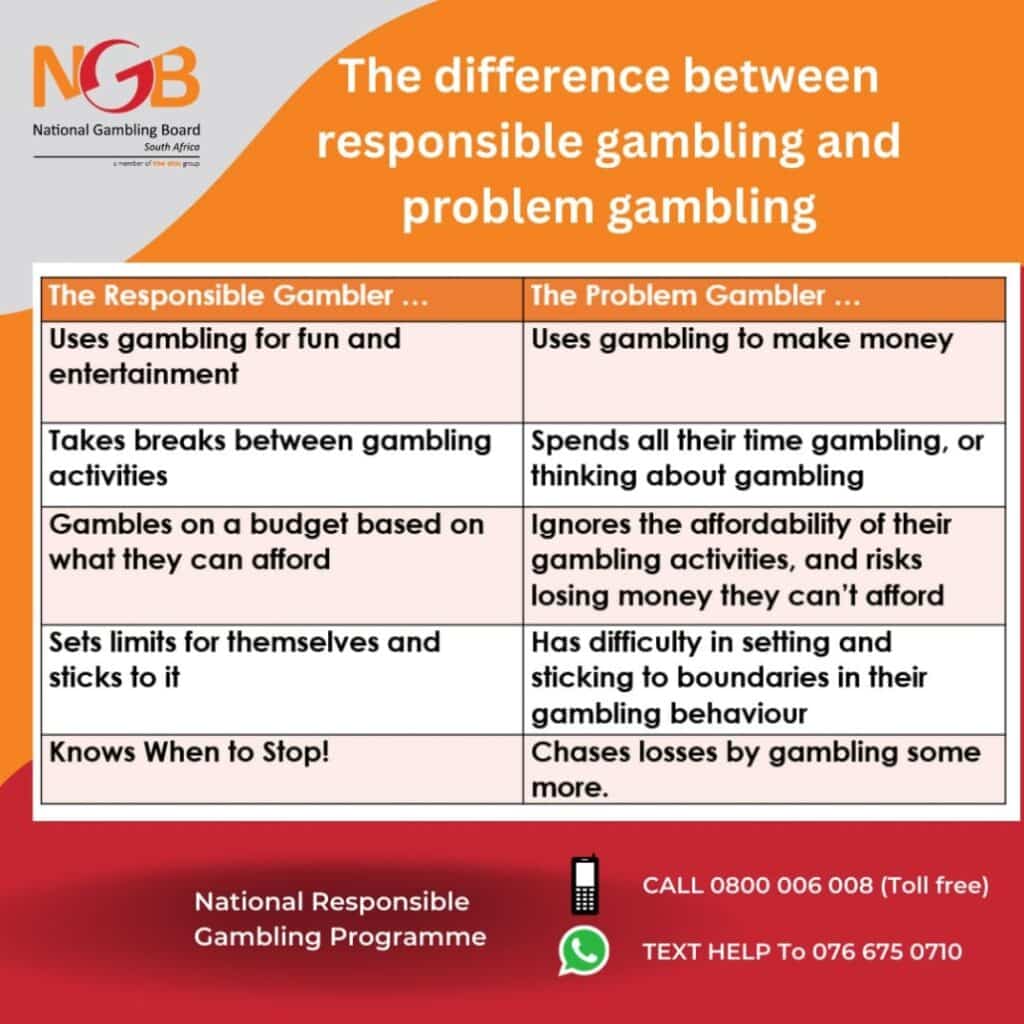
The defining distinction between recreational gambling and problem gambling is simple: casual gamblers can stop when they’re losing. As SARGF’s slogan reminds us, “Winners know when to stop”.
People with a gambling addiction can’t stop themselves from gambling.
If you’re still uncertain whether your gambling is a problem, you can use the South African Responsible Gambling Foundation’s self-assessment tool to find out where you score on the Canadian Problem Gambling Index.
The gambling addiction self-assessment tool uses a simple 10-question multiple-choice quiz to give you a score out of 30 based on your answers. Participation is anonymous, with no personal or identifying information collected.
How to quit gambling: Tips and where to start
Stopping gambling is rarely as simple as deciding to stop. The urge to gamble runs through the same neural pathways as substance addiction, and the pattern of behaviour is deeply entrenched by the time most people try to quit. That said, some practical steps can help interrupt the cycle, particularly in the early stages:
- Acknowledge the problem honestly. Denial is one of the defining features of gambling addiction. Recognising that gambling has become unmanageable is a necessary starting point.
- Tell someone you trust. Isolation reinforces addiction. Bringing another person into the picture creates accountability and opens the door to practical support.
- Block access to gambling apps and websites. Tools like BetBlocker and Gamban block gambling sites across your devices. See the section below for more details on blocking options and self-exclusion.
- Remove saved payment details from betting sites. Having to re-enter card details adds friction that can interrupt an impulse before it becomes a transaction.
- Ask someone you trust to help manage your finances temporarily. Limiting your own access to funds reduces the practical ability to act on an urge, even when the urge itself is strong.
- Identify and avoid your triggers. A specific emotional state or situation precedes most gambling urges. Knowing your triggers makes it possible to plan for them.
- Request voluntary self-exclusion. You can request self-exclusion from gambling operators directly or through your provincial gambling board. Self-exclusion is binding for a minimum of six months.
- Take advantage of free gambling addiction resources. Reach out to the SARGF National Responsible Gambling Programme for free gambling counselling and support. Call them toll-free on 0800 006 008, or email helpline@responsiblegambling.org.za.
- Contact Gamblers Anonymous. Gamblers Anonymous South Africa offers free peer support from people with lived experience of gambling addiction. Meetings are available across the country.
These steps can help interrupt the pattern, but they’re not a substitute for clinical treatment where the addiction has become severe. If you’ve tried to stop gambling before and returned to it, gambling rehab is worth considering seriously, especially if your gambling is affecting your mental health.
How to block gambling sites and self-exclude in South Africa
Two practical tools can reduce access to gambling before urges arise: site-blocking software and formal self-exclusion. Neither replaces clinical treatment for a serious addiction, but both create friction that makes it harder to act on an impulse to gamble.
Site-blocking tools
Gambling-blocking software prevents access to betting sites and apps across your devices. BetBlocker is free and covers over 30,000 gambling sites. Gamban is a paid option with broader coverage across mobile apps and devices. Both are difficult to remove without a waiting period, which is part of what makes them effective.
For blocking at the network level, covering all devices on your home Wi-Fi rather than one at a time, you can change your router’s admin settings to blacklist specific sites, or use a DNS-based service like OpenDNS or Control D to block gambling sites as a category. This approach is particularly useful for family members trying to limit access at home.
Self-exclusion in South Africa
Self-exclusion is a formal request to be barred from gambling for a fixed period. You can apply directly through a gambling operator’s security department, or download a self-exclusion form from your provincial gambling board’s website (e.g., Gauteng).
Once submitted, self-exclusion is binding for the period you request, typically six months to five years. The SARGF National Responsible Gambling Programme can assist with the process and also provides free counselling support.
Warning signs of gambling addiction
According to the South African Responsible Gambling Foundation, a disordered gambler may exhibit signs that are visible to people close to them before they acknowledge the problem themselves.
You might notice the person becoming more withdrawn, seeming tired a lot, or suddenly asking for money or loans. They seem lost or report feeling hopeless. They seem worried or agitated without a clear reason, or spend long periods of time alone or away from home.
Warning signs of gambling addiction in someone you care about include:
- Withdrawing from family, friends, and activities they previously enjoyed
- Spending a lot of time on their phone or computer, but still being hard to reach
- Hiding their phone or computer screen when you enter the room
- Secrecy around their finances, especially if they were previously transparent
- Extended absences from home, work, or studies
- Dropping out or quitting their job
- Frequently talking about financial problems and stressing about money
- Noticeable changes in mood or behaviour
- Changes in sleeping patterns (sleeping too much or not enough)
- Uncharacteristically generous spending, or suddenly treating friends and family to expensive gifts
- Unexplained income without a change in their career circumstances
- Unexplained anxiety, agitation, restlessness, or irritability (which may lead to fights)
- Requesting money or loans, often with vague explanations
If several of these signs are familiar and you’re worried about someone you care about, our team is available for a confidential conversation. We can help you understand what you’re seeing and talk through your options. Call us on +27 11 787 9142, or fill in our contact form and we’ll get back to you.
How to help someone with a gambling addiction
Watching someone you care about struggle with gambling is distressing, particularly when they deny there’s a problem or become defensive when you raise it. There are things you can do to support them without enabling the behaviour or damaging your relationship.
Here are some practical steps for helping someone with a gambling problem:
- Educate yourself about gambling addiction. Understanding that gambling disorder is a recognised medical condition (not a moral failing) will help you approach the conversation without blame or judgement. This can make them more receptive to what you have to say.
- Choose the right moment. Raise the subject when things are calm, not in the middle of a crisis or immediately after a gambling incident. Avoid ultimatums unless you’re prepared to follow through.
- Focus on behaviour, not character. Describe what you’ve observed and how it’s affected you, rather than labelling the person as irresponsible or dishonest.
- Don’t cover losses or lend money. Paying off gambling debts removes a consequence that might otherwise motivate the person to seek help. It’s one of the most common forms of enabling, and it’s usually done out of genuine care.
- Block access to gambling sites. Install Gamban or BetBlocker on their devices, or block gambling sites at the router level so all devices on your home network are covered. See the section above on blocking tools and self-exclusion for the full options.
- Set boundaries for yourself. Supporting someone with an addiction is emotionally demanding. Knowing what you’re willing and unwilling to do protects both of you.
- Encourage them to seek help and offer to assist with the practicalities. Many people are more likely to take the first step if someone offers to help them find a facility, make the call, or accompany them to an evaluation.
- Join a support group for the family of gambling addicts. Gam-Anon is a free 12-step fellowship for the partners, relatives, and close friends of people with compulsive gambling disorder. Meetings are available in South Africa.
If you’re trying to get someone into treatment for gambling addiction and aren’t sure where to start, our team can guide you through the intervention process.
Overcoming gambling addiction: What treatment involves
Houghton House offers both inpatient or residential rehab and outpatient treatment programmes for gambling disorder.
Gambling rehabilitation at Houghton House draws on the same evidence-based treatment model used for treating substance use disorders, which includes psychiatric care for co-occurring conditions.
Gambling disorder frequently co-occurs with depression, anxiety, and PTSD, and treating the addiction without addressing those underlying conditions tends to produce short-lived results.
Our gambling addiction rehabilitation programme includes:
- A comprehensive intake assessment and personalised treatment plan that addresses underlying causes and supports lifestyle changes
- Group therapy sessions and 12-step programme integration
- Individual counselling for gambling addiction, including cognitive behavioural therapy (CBT) to address distorted thinking and loss-chasing patterns, and dialectical behaviour therapy (DBT) for developing emotional regulation and distress tolerance
- Family support sessions and relapse prevention planning
- Psychiatric care and medication management, where needed
- Aftercare, outpatient sessions, and halfway house options for step-down support
For more information about the programme, see our gambling rehab page, or get in touch.
Frequently asked questions about gambling addiction
Is gambling addiction a real medical condition?
Yes. Gambling disorder is formally recognised in both the DSM-5 and ICD-11 as a behavioural addiction, with the same diagnostic criteria as substance use disorders: preoccupation, tolerance, withdrawal, loss of control, and continued behaviour despite harm.
Can gambling addiction be overcome?
Yes. With the right clinical support, most people with gambling addiction can achieve lasting recovery. The addiction is deeply reinforced by the time most people seek help, which is why self-directed attempts to quit often fail — not because recovery isn’t possible, but because the underlying psychological drivers haven’t been addressed. Treatment that combines therapy, psychiatric assessment, and structured residential care tends to produce significantly better outcomes than willpower alone.
Is there a gambling helpline in South Africa?
Yes. The South African Responsible Gambling Foundation (SARGF) runs a free, confidential helpline available around the clock. Call 0800 006 008 or WhatsApp 076 675 0710. The helpline provides counselling, referrals, and assistance with self-exclusion.
How do I report a gambling problem?
If you’re concerned about your own gambling, you can contact the SARGF helpline at 0800 006 008 for free counselling and a referral to treatment. If you’re worried about someone else, the same helpline can advise you on how to approach the situation. For self-exclusion from gambling operators, contact the operator directly through their security department, or submit a self-exclusion form through your provincial gambling board.
Does medical aid cover gambling addiction treatment?
Not directly. In South Africa, gambling disorder isn’t classified as a Prescribed Minimum Benefit (PMB), which means medical aids aren’t required to cover it.
However, gambling addiction frequently co-occurs with mental health conditions like depression, anxiety, or trauma that require specialised psychiatric care and do qualify for medical aid cover under psychiatric PMBs, as long as the treatment meets certain requirements.
As a fully-licensed private psychiatric hospital, Houghton House is one of the few rehabilitation centres in South Africa that meet these criteria. This means our patients can claim for psychiatric services for qualifying conditions covered under their medical aid’s psychiatric PMBs.
Contact our admissions team with your medical aid details, and we’ll confirm what’s available and manage pre-authorisation on your behalf.
See how medical aid covers rehab at Houghton House.
Is online gambling addiction treated differently from other forms?
The underlying addiction is the same regardless of how someone gambles. Online gambling often means the addiction has developed faster and in greater secrecy, which can affect how the clinical team approaches treatment, but the programme itself is the same.
How long does gambling addiction treatment take?
At Houghton House, most patients begin with 21 days of primary inpatient care, followed by a step-down phase in our secondary care facility. The clinical team can extend the programme where indicated. Our admissions team will advise on the most appropriate duration based on your situation.
What is responsible gambling, and when does it become a problem?
Responsible gambling means gambling within limits set in advance, keeping it recreational, and stopping when you choose to, not because you’ve run out of money. When gambling stops being a choice and becomes a compulsion, it has crossed into problem gambling territory.
The South African Responsible Gambling Foundation (SARGF) recommends setting strict time and money limits, never chasing losses, and treating gambling as entertainment rather than income. When those limits no longer hold, when you’re chasing losses, hiding how much you gamble, or feeling unable to stop, responsible gambling has crossed into a gambling problem.
The SARGF offers a free, confidential helpline at 0800 006 008 for anyone concerned about their own gambling or that of someone they care about.
How to quit gambling?
Quitting gambling is rarely as simple as deciding to stop. By the time most people try to quit, the compulsion is deeply entrenched, and the psychological patterns that drive it are well established. Practical steps that help include blocking gambling apps and websites, requesting self-exclusion from operators, removing saved payment details, and contacting the SARGF helpline or Gamblers Anonymous for support. Where those steps haven’t been enough, residential treatment addresses the underlying drivers that sustain the addiction. The “how to quit gambling“ section above covers each of these steps in more detail.
Get gambling addiction help at Houghton House
If gambling has become unmanageable for you or someone you care about, our team is available for a confidential conversation. We can help you understand your options, clarify what your medical aid covers, and guide you through the admission process at your own pace.
Call us at +27 11 787 9142, or fill in our contact form.
